Skip to content

Most UK small businesses spend £500 to £1,500 per month on SEO, while competitive SME campaigns typically sit between £1,500 and £5,000 per month. A basic local campaign can cost less, but the price only makes sense when you know exactly which work is included.
You're probably reading this after opening three proposals that look as though they've been written for entirely different planets. One says £200 a month, another asks for £1,500, and the third wants £5,000 before anyone has explained what happens after the invoice lands. That's a perfectly reasonable way to lose an afternoon and develop a mild distrust of bullet points.
Table of Contents
- Why UK SEO Quotes Look So Confusing at First Glance
- The Three Pricing Models You Will Encounter
- What Each Price Band Actually Buys Your Business
- The Factors That Push Your Campaign Cost Up or Down
- Spotting the Difference Between White Hat and Dodgy Shortcuts
- How AI Search Is Changing What SEO Retainers Should Include
- Your Framework for Evaluating Any UK SEO Quote
Why UK SEO Quotes Look So Confusing at First Glance
A local business owner might receive one quote for basic Google Business Profile work, another for technical fixes and content, and a third for a full campaign involving research, authority building and regular optimisation. All three providers may call the service “SEO”, but they're selling different amounts of attention, expertise and implementation.
The broad market is segmented. Independent UK benchmarks place basic local SEO at roughly £200 to £800 per month, full-service retainers at £1,200 to £5,000, and technical SEO audits or implementation at £750 to £5,000 as a one-off. For many small UK businesses, the practical working range is £500 to £1,500 per month, according to UK SEO pricing benchmarks for 2026.
Your first useful price anchor
A single-location electrician in a moderately competitive town may need local landing pages, Google Business Profile improvements, citation corrections, technical maintenance and a modest content programme. That's a very different job from helping a solicitor with five offices compete across several cities.
For SMEs chasing competitive terms, the market commonly centres on £1,500 to £5,000 per month, because sustained content production, link acquisition and technical maintenance need enough resource to keep moving. Independent UK guidance on SEO pricing makes the important point that under-resourced campaigns often struggle because rankings depend on several inputs working together, not on one magical blog post.
Practical rule: Compare the work, not the monthly figure. A cheap quote with no implementation may cost more than a properly scoped campaign that fixes the problems holding your site back.
Why the market has such a wide spread
Pricing varies because providers package SEO differently. A freelancer may sell specialist time, a small team may bundle content and technical work, and a larger operation may include strategy, reporting and several specialists. Quotes also differ because one business needs a single service area while another needs location pages, multiple profiles and wider authority building.
The commercial environment explains why search visibility carries serious value. The UK digital advertising market reached £40.5 billion in 2025, up 10% year-on-year, with search accounting for 44% of digital ad spend, implying roughly £17.9 billion in search advertising. Those figures come from IAB UK's adspend data, and they show why businesses continue competing fiercely for high-intent searches.
The Three Pricing Models You Will Encounter
SEO providers generally charge through a monthly retainer, a project fee or an hourly rate. None is automatically right or wrong. The sensible choice depends on whether you need a defined repair, ongoing growth or flexible access to specialist input.
Monthly retainers
A retainer gives a local business predictable spending and continuous work. A Leeds plumber paying around the lower local-business range might receive regular on-page improvements, local profile maintenance, technical checks, content planning and reporting, provided the quote spells those items out.
The strength is continuity. Someone keeps watching competitors, updates pages, fixes issues and builds the next stage of the campaign. The weakness is vagueness. “SEO management” can mean a busy month of useful implementation or a polished report containing little more than coloured arrows.
Local campaigns are often benchmarked at £249 to £599 per month for a single location, £599 to £1,500 for roughly three to ten locations, and £1,500 or more for chains, as outlined in UK local SEO cost guidance.
Project-based fees
A project fee suits a defined problem. A business preparing a redesign might commission a technical audit, migration plan or implementation project, then use the findings internally or as the foundation for ongoing work.
For example, a £3,000 project could be sensible if it delivers a detailed crawl analysis, prioritised fixes, keyword mapping, internal-link recommendations and implementation support. It's poor value if it produces a long document that nobody acts upon.
Project work offers a clear endpoint and controlled cash flow, but it doesn't create momentum by itself. Search competitors continue publishing and improving while your audit gathers dust in a shared drive.
Hourly rates
Hourly billing works when you know precisely what needs doing. A plumber could hire a consultant for a technical review, page rewrites or guidance for an in-house developer, then stop once the task is complete.
It can also expose the true cost of small changes. A seemingly minor template fix may involve investigation, developer coordination and testing. The risk is that the business pays for activity rather than progress, particularly when nobody has agreed which commercial pages matter most.
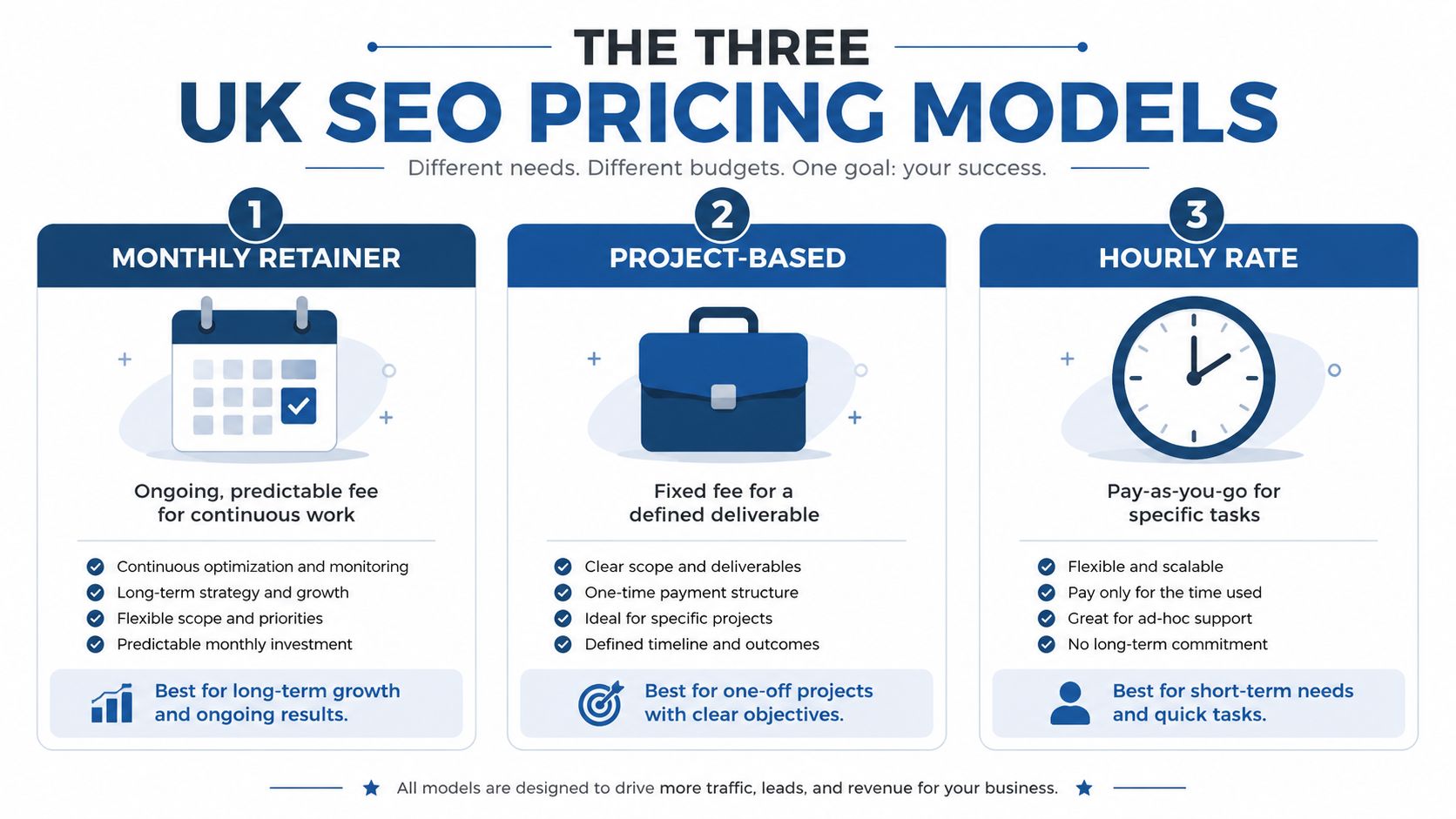
Choose a retainer when you need sustained growth, a project when the problem has a defined boundary, and hourly support when you already have a strategy and only need specialist execution. Most local firms need a retainer eventually, but starting with an audit can be the grown-up move when the website is in an unknown state.
What Each Price Band Actually Buys Your Business
Price bands only help when they're tied to scope. The following structure separates Foundations, Authority and Market Leader work, so you can compare a quote by deliverable rather than by decorative package names.
| Price Band | Monthly Cost | Best For | Core Deliverables |
|---|---|---|---|
| Foundations | £200 to £800 for basic local SEO, with many small-business campaigns sitting at £500 to £1,500 | Single-location trades, modest local competition | Initial audit, keyword research, on-page fixes, Google Business Profile work, citation and NAPW corrections, basic technical maintenance, reporting |
| Authority | £1,500 to £5,000 | Competitive SMEs, professional services, regional businesses | Technical implementation, competitor analysis, service and location pages, ongoing content, internal linking, legitimate authority acquisition, local SEO maintenance, reporting |
| Market Leader | £5,000 to £20,000+ | Enterprise sites, chains and broad competitive markets | Multi-location strategy, advanced technical work, substantial content operations, digital PR or authority acquisition, entity and AI visibility work, custom reporting and wider marketing integration |
Foundations
A single-location electrician usually needs the fundamentals done properly before anyone talks about grand conquest. That means mapping services to searches, correcting titles and headings, checking indexability, improving the main service pages and making the business information consistent across relevant local listings.
This band can work when the target area is contained and the website needs focused improvement. It won't fund an endless stream of new pages, intensive digital PR or a large-scale link acquisition programme. Nor should it pretend to.
Authority
A regional solicitor with five offices needs more. Each office may require properly differentiated location content, accurate business information, stronger service architecture, internal links and a steady programme of useful content. Competitive professional services also need convincing trust signals, not generic articles assembled by a content sausage machine.
At this level, the campaign has enough resource for continuous optimisation and authority building. The provider should explain which pages will be created or improved, how competitors will be assessed and how technical recommendations will reach the live website.
Market Leader
The highest band is for complicated websites, multiple locations or markets where established competitors have deep content and authority. It can include specialist technical teams, wider content production, advanced schema, entity development, digital PR and reporting connected to commercial outcomes.
The key point is simple. Paying more doesn't automatically make a campaign better. Paying for the wrong scope merely buys a more expensive version of confusion.
The Factors That Push Your Campaign Cost Up or Down
Two businesses in the same industry can need completely different budgets. A Leeds plumber targeting emergency searches faces a contained local challenge. A national accountancy firm targeting contractor tax-planning terms faces broader competition, a larger content requirement and a more demanding trust environment.
Start with these cost drivers.
Keyword competitiveness
Some searches attract businesses with strong websites, established brands and serious authority. Others have thinner local competition. The provider should show the commercial terms being targeted and explain what currently ranks for them.
A campaign aimed at a handful of service-and-location phrases needs less content than one targeting a whole topic area with supporting guides, comparison pages and specialist advice.
Geographic scope
One town is simpler than a region. Several offices multiply the work because each location needs accurate profile information, locally relevant pages and a coherent internal structure. Copying one town page and changing the place name is not a strategy. It's how websites acquire a collection of near-duplicate pages that nobody enjoys reading.
Website health
A site with broken internal links, poor indexing, weak templates or migration problems needs technical attention before content expansion will perform properly. A healthy site can put more budget towards content and authority.

Content and authority requirements
Content costs rise when you need expert input, original research, several service pages or frequent updates. Authority work also varies. Legitimate outreach and editorial link acquisition require judgement and relevance. A spreadsheet of random directory submissions is cheaper, but it's not an equivalent substitute.
Before accepting a quote, consider getting marketing clarity with an audit. A clear diagnosis helps you spend on the constraint that matters, rather than funding whatever deliverable happens to be easiest to list.
Use the cost drivers as a quick self-assessment. If you serve one area, have a sound website and face modest competition, Foundations may be appropriate. If you serve several locations, compete in law, finance or another crowded sector, and need new content plus authority, expect the Authority band to be more realistic.
Spotting the Difference Between White Hat and Dodgy Shortcuts
Cheap SEO often looks attractive because the invoice is tidy. The trouble starts when the provider explains the low price with tactics that search engines classify as manipulation.
White-hat SEO improves the website, its usefulness and its credibility. It includes technical optimisation, clear information architecture, helpful content, accurate local information and authority earned through relevant relationships or editorial coverage.
Grey-hat SEO sits in the uncomfortable middle. The provider may use tactics designed to exploit weaknesses or manufacture signals while insisting they're merely being clever. Cleverness is not a business strategy when an algorithm update or manual review can erase the benefit.
Black-hat SEO deliberately manipulates rankings through tactics that violate search-engine policies. It's the digital equivalent of putting a fake moustache on a forged identity document. It may look convincing briefly, until somebody checks.
Google's policies state that buying or exchanging links for ranking purposes counts as link spam, while hidden text and keyword stuffing are also treated as spam. The distinction is set out in this explanation of Google's spam-policy boundaries.

Warning signs in a proposal
Be cautious when a provider offers:
- Guaranteed rankings: Nobody controls Google's results, so guaranteed positions deserve a raised eyebrow.
- Bulk link packages: Ask where links come from, why they're relevant and whether the provider is buying or exchanging them for ranking purposes.
- Keyword stuffing: Repeating a phrase until the page sounds like a malfunctioning satnav damages readers' trust and can breach spam guidance.
- Hidden text: If content is invisible to users but added for search engines, walk away.
- Secret methods: A credible consultant can explain the work without wrapping it in theatrical fog.
White-hat work can take patience because it involves real improvements and genuine evidence. That's precisely why it has lasting value. A transparent provider should report what changed, what was learned and which commercial pages deserve the next investment.
How AI Search Is Changing What SEO Retainers Should Include
Modern search visibility isn't limited to a blue link. Businesses increasingly want their information understood by systems that summarise answers, identify entities and select sources. That doesn't make traditional SEO obsolete. It makes weak, poorly structured websites even less defensible.

A modern retainer should consider schema markup, a logical internal-linking architecture, clearly authored content, consistent business information and pages that answer specific customer questions directly. It may also include content designed to demonstrate experience, expertise, authoritativeness and trust, alongside optional llms.txt implementation where the technical and strategic case is clear.
The buyer's question is whether these additions support visibility and enquiries or merely inflate the invoice. “AI optimisation” isn't a deliverable until the provider explains what they'll change, why it matters, how it will be monitored and which business pages benefit.
What sensible AI-aware work looks like
For a home-services firm, useful work might include a well-structured service page, clear areas served, evidence of experience, answers to common customer concerns and consistent organisation details. For a solicitor, it may involve authoritative explanatory content, transparent credentials, carefully connected service pages and structured data that helps systems interpret the firm.
No honest consultant can promise that a particular AI system will cite a business. They can improve the clarity, credibility and machine-readability of the information available.
This short video offers useful visual context for how AI-assisted search interfaces are presented:
A retainer deserves its price when it turns these ideas into implemented work, not when it adds fashionable labels to an unchanged checklist. Ask for examples of schema changes, content briefs, internal-link improvements and reporting. If the answer is a cloud of terminology, keep your wallet safely in its coat pocket.
Your Framework for Evaluating Any UK SEO Quote
A useful quote should let you understand what happens to your website, not merely admire the provider's vocabulary. Start by matching the proposed scope to your actual market. A single-location trades business doesn't need the same operating model as a multi-location professional firm.
Ask for precise answers:
- Content output: How many pages, guides or updates are included, and who approves the topics?
- Technical scope: Does the audit cover crawlability, indexing, internal links, templates, structured data and implementation?
- Authority work: Will the provider earn relevant coverage, build citations, conduct outreach or submit directories?
- Local visibility: Who manages the Google Business Profile, location information, reviews and NAPW consistency?
- Reporting: Will you see rankings, organic traffic, completed work, priorities and meaningful enquiry measures?
- Commercial terms: Are setup fees, notice periods or lock-ins hidden outside the headline price?
Content deserves particular scrutiny. A useful guide to how SEO content pricing works can help you distinguish strategic writing and optimisation from a word-count exercise. More words don't automatically create more customers. The subject, search intent, expertise and page quality matter far more than a celebratory tally of articles.
The quote should survive comparison
Put competing proposals into the same structure. Record the monthly cost, hours or output, technical implementation, content responsibility, authority activity, local work and reporting. If one provider refuses to specify the scope, you haven't received a comparable quote.
For small UK businesses, a package such as the DigiVisi SEO package can be assessed using this same checklist. Look for audits, keyword and competitor research, page optimisation, internal linking, schema, local citation work, content and transparent tracking rather than accepting a package name as proof of value.
DigiVisi Ltd offers SEO packages for small, service-led UK businesses, with transparent reporting, technical and local optimisation, content aligned with search and AI visibility, and monthly billing without contracts. Visit DigiVisi Ltd to review the available approach and discuss a campaign matched to your market, locations and lead goals.